Urstag
Free tool

Concrete calculator: volume in m³ and mix

Pick the shape, enter the dimensions and the concrete class. You get the cubic metres you need right away, plus how many bags of cement and how much sand, gravel and water to order.

  • Slabs, footings, columns
  • Mixes from C8/10 to C30/37
  • Per-bag dosage for a site mixer
01 · What are you pouring?
For slabs, floors, pads and paths. Enter the thickness in centimetres.
02 · Dimensions
Allowance for waste
Some concrete is always lost while pouring and compacting. 5-10% is the usual allowance.
03 · Concrete class
Cement bag
Result · C16/20
Concrete needed
12.6 m³
includes 5% waste
Cement
3,780 kg95 bags × 40 kg
Sand 0-4 mm
9.2 t≈ 5.75 m³ loose
Gravel 4-31 mm
13.86 t≈ 9.24 m³ loose
Water
2,331 L
If you use all-in ballast (0-31 mm) instead of separate sand and gravel: about 23.06 t.
In a site mixer, per 40 kg bag
  • 6.1 buckets of sand
  • 9.8 buckets of gravel
  • 25 L of water
10 L bucket, dry aggregates. If the sand is wet, use less water.
Indicative values for 1 m³ of concrete, with CEM II 42.5 cement and dry aggregates, no admixtures.
Producing concrete every day?

Which batching plant fits you

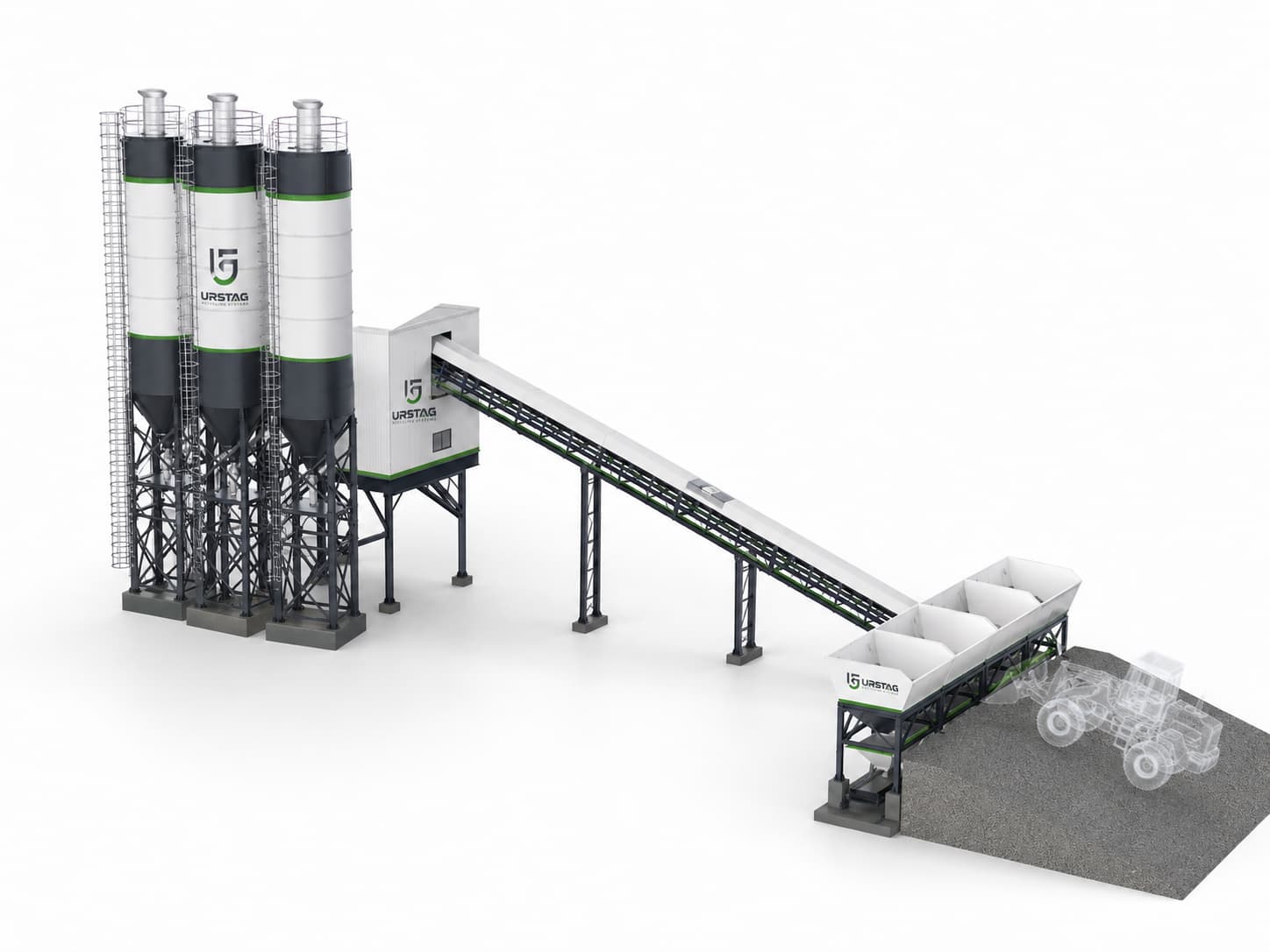
If you pour constantly, your own plant gives you control over the mix and the schedule. Tell us how much concrete you produce per day and we show you the URSTAG plants that fit.

Concrete mixes

Concrete mixes by class, per 1 m³

Indicative amounts of cement, sand, gravel and water for the most common concrete classes. The higher the class, the more cement and the lower the water/cement ratio.

ClassCementSand 0-4Gravel 4-31WaterTypically used for
C8/10220 kg780 kg1170 kg190 LBlinding, fill concrete
C12/15270 kg750 kg1130 kg190 LSimple footings, paths
C16/20300 kg730 kg1100 kg185 LHouse foundations, floors
C20/25340 kg710 kg1070 kg185 LSlabs, columns, ring beams
C25/30380 kg690 kg1040 kg180 LStructures, industrial pads
C30/37420 kg670 kg1010 kg180 LHeavily loaded structures, precast
Indicative values for 1 m³ of concrete, with CEM II 42.5 cement and dry aggregates, no admixtures.

How to calculate cubic metres of concrete

Volume is length times width times height, all in metres. Convert centimetres to metres first (15 cm = 0.15 m), then add 5-10% for waste.

Slab / screed

V = L × W × thickness
A 10 m × 8 m slab, 15 cm thick: 10 × 8 × 0.15 = 12 m³.

Strip footing

V = total length × width × depth
40 m of footing, 40 cm wide and 80 cm deep: 40 × 0.4 × 0.8 = 12.8 m³.

Column / beam

V = a × b × h × pieces
6 columns of 30 × 30 cm, 3 m high: 0.3 × 0.3 × 3 × 6 = 1.62 m³.

Round column

V = 3.14 × r² × h × pieces
4 round columns, 30 cm diameter, 3 m high: 3.14 × 0.15² × 3 × 4 ≈ 0.85 m³.

Concrete FAQ

Short answers to what builders and our customers ask us most often.

See our batching plants
How much cement goes into one cubic metre of concrete?
It depends on the class. As a guide, with CEM II 42.5 cement: about 220 kg for C8/10, 300 kg for C16/20, 340 kg for C20/25 and 420 kg for C30/37.
How many bags of cement do I need for 1 m³ of concrete?
For C16/20 concrete (300 kg of cement per m³) you need 7.5 bags of 40 kg. For C20/25 (340 kg per m³), 8.5 bags of 40 kg. Always round up.
How much sand and gravel per bag of cement in a mixer?
For C16/20 concrete, one 40 kg bag takes about 6 buckets of sand, 10 buckets of gravel and 25 L of water (10 L bucket, dry aggregates). If the sand is wet, reduce the water.
What concrete class is used for a house foundation?
The structural engineer sets the class, based on the soil and the structure. Ordinary houses often use C16/20 or C20/25. Never go below the class in the design.
How much should I add for waste?
Usually 5% for slabs and simple pours, up to 10% for footings on uneven ground or pumped pours. A little leftover concrete costs less than stopping a pour.
Can I use all-in ballast instead of separate sand and gravel?
Yes, all-in ballast (0-31 mm) is a natural blend of sand and gravel and is common for everyday concrete. For higher classes, separately graded aggregates give a more consistent concrete.
When is it worth having your own batching plant?
When you produce concrete constantly, for your own sites or for sale, and want control over the mix, the quality and the delivery schedule. URSTAG plants range from 20-60 m³/h mini plants to 60-270 m³/h commercial plants.